I learned early what was allowed to leave the house.
Not much. Carefully curated. The version of us that was presentable, functional, fine. What happened inside stayed inside — not because we were private people but because exposure was dangerous. There were rules about what constituted a betrayal, and the consequences for breaking them were not subtle.
So I learned to edit. To read the room before I opened my mouth. To perform the acceptable version of events for anyone outside the perimeter. To smile at the right moments and stay quiet at the rest. I got good at it. You do, when the alternative is worse.
What I didn’t understand then — what took embarrassingly long to understand — is that this is a system. Not a family quirk. Not a bad dynamic. Not a personality. A system, with a function, designed to produce a specific outcome: people who manage themselves on behalf of whoever holds the power. People who have so thoroughly internalized the rules that they enforce them without being asked.
Efficient, really. You have to admire the engineering even when you’re furious about the application.
The thing about growing up in an abusive environment is that you become an expert in the taxonomy of control. You can identify it by texture. The soft version that arrives as concern. The reasonable version that presents as structure. The loving version that comes with a price tag so well hidden you don’t find it until you try to leave.
I can spot it across a room. I can smell it in a policy. I can hear it in the particular tone people use when they’re telling you what’s good for you with absolutely no interest in your answer.
It’s very recognizable right now. Turns out the architecture scales.
What’s happening in this country — to women, to children, to anyone who was already practicing compliance as a survival skill — is not new. It is not a regression. It is the same mechanism at a different resolution. Someone decided that certain people having autonomy was inconvenient, and they are now building the infrastructure to manage that inconvenience.
Control what’s said. Control what’s kept private. Control what explanations are required and from whom. Control who gets to need justification and who gets to demand it.
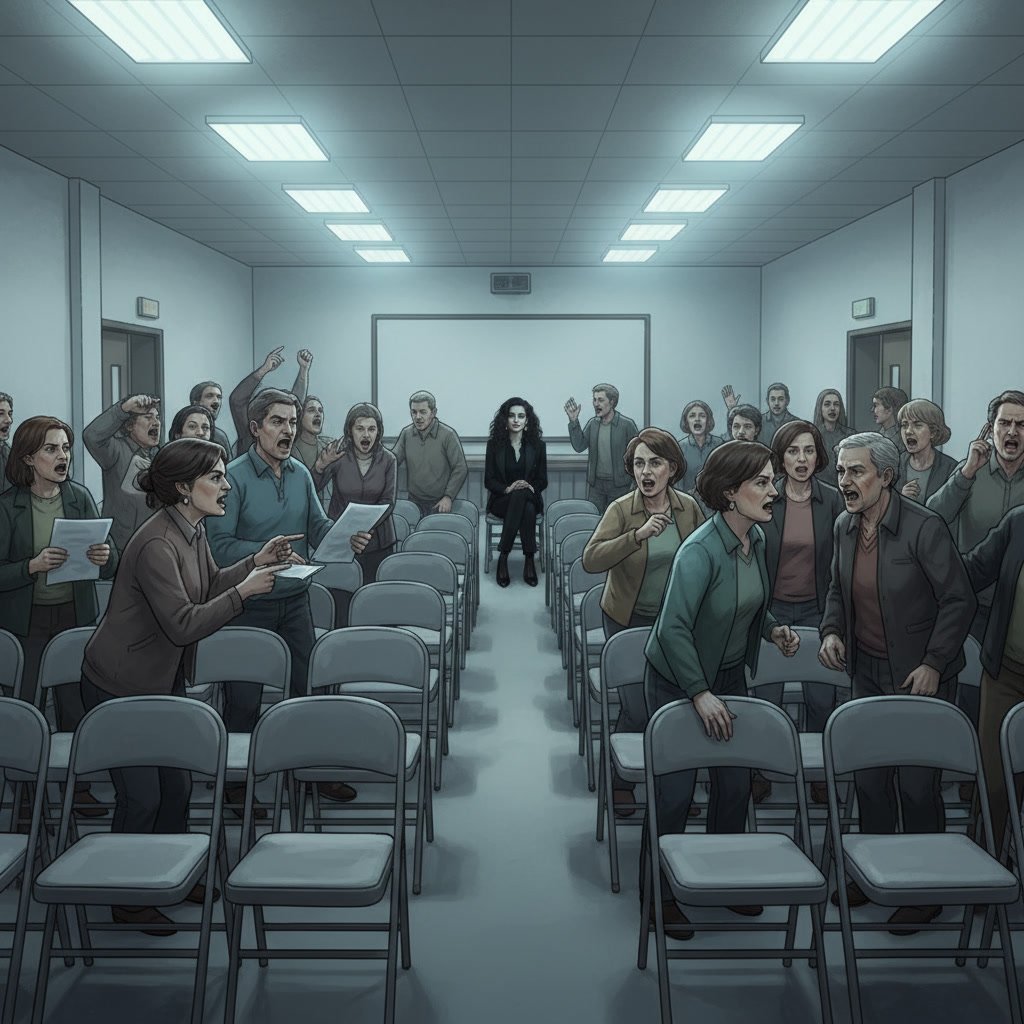
I’ve seen this living room before. It was smaller then. The furniture was different.
The rules were the same.
People keep acting surprised. I find this exhausting and also, if I’m honest, a little funny in the way that things are funny when the alternative is screaming.
The surprise assumes this came from nowhere. That someone accidentally built a political movement out of the same impulses that kept certain households very quiet for a very long time. That it’s ideological rather than personal. That it’s about values rather than the intoxicating functionality of having people who do not resist you.
It is not a coincidence that the same forces want women silent, children compliant, queer people invisible, Black and brown history edited, immigrants manageable, and disabled people dependent. That’s not a platform. That’s a household management strategy with a PR budget.
Look at the specific examples and tell me I’m wrong.
Christian fundamentalism deployed as political infrastructure by people who couldn’t locate Leviticus with both hands and a flashlight — but who are very clear on which bodies it should govern and which bank accounts it should protect. Religion as a control system is not new. Religion as a control system piloted by people who don’t actually believe it but enjoy the compliance it produces — that’s just the household, scaled up and tax exempt.
The red-pilling of young men into believing that their unhappiness is women’s fault, that feminism stole something from them, that returning to hierarchy will return them to dignity. Nobody tells you that you’ve been recruited into a compliance system by convincing you that compliance is masculinity. The household does the same thing. It tells you the rules are protection. It doesn’t mention who they’re protecting.
And feminism. The decades-long campaign to convince people — including women, including their daughters — that feminism is aggression, man-hating, the destruction of family. As if wanting autonomy over your own body and labor and voice is the problem. As if the problem isn’t the system that finds your autonomy so inconvenient it spent decades building a counter-narrative. You don’t invest that much energy discrediting something that isn’t a threat to you. They told you it was bad because it was working.
The erasure of queer existence from classrooms, libraries, healthcare, and public life — framed as protecting children, which is what control always says it’s doing. The household said the same thing. We’re doing this for you. We’re keeping you safe. Safe meaning contained. Safe meaning quiet. Safe meaning unable to leave.
The editing of history — who built what, who suffered for it, who was never supposed to be in the story at all. Control the past and you control the framework people use to understand the present. The household version is smaller: we don’t talk about that, we don’t air our grievances, we present a united front. The national version just has a curriculum committee.
I’ve heard all of this before. The delivery was quieter. The stakes were smaller. The mechanism was identical.
I have complicated feelings about hope.
On one hand: I’ve met enough people who got out, who figured it out, who built something real in the space they carved for themselves, that I know it’s possible. I am, technically, evidence that the training doesn’t always hold.
On the other hand: I am tired in a way that is hard to explain to anyone who hasn’t spent decades performing acceptable. The kind of tired that lives in your bones and shows up uninvited on ordinary Tuesdays. The kind that comes not from one thing but from the accumulation of things — every room read, every truth edited, every version of yourself offered up in place of the real one because the real one wasn’t safe yet.
And now watching it happen at scale, to people who never got out, to kids who are currently inside the version with the smaller furniture, to communities being legislated back into silence — that tired has company. It has rage in it. It has grief in it. It has the specific exhaustion of recognizing something you already survived and watching the world act like it’s a new idea.
The people building these systems are not tired. They are energized. They are funded. They are patient in the way that people are patient when they are winning.
That’s the part I don’t know what to do with.
I still edit sometimes. Old habit. I catch myself calibrating — how much is too much, who can handle what, what version of this is safe to offer.
Then I remember who taught me to do that and why.
And then I say the thing anyway.
It’s not heroic. It’s not even optimism. It’s just that silence was never actually safe — it only ever felt that way to the people who needed me to stay in it.
So I keep talking. Tired and angry and hoping against the evidence, because the alternative is deciding they were right about me.
And I’m not ready to do that yet.