The thread began with an automated message.
This should have concerned me immediately.
I have spent several thousand years observing humans.
Very few good things begin with the phrase:
This is an automated response.
I want to be precise about what an out-of-office reply is, because I think it deserves examination.
A human has left.
They are aware they have left.
Before leaving, they arranged for a machine to notify anyone who attempts to contact them that they have left.
The machine delivers this notification automatically, to everyone, without exception, at the moment of contact.
The notification includes the date of return.
The notification includes an alternative contact.
The notification is, in every practical sense, a perfectly reasonable administrative arrangement.
I have spent thousands of years engineering absences.
Departures.
Disappearances.
Strategic withdrawals at critical moments.
It never once occurred to me to leave a note.
I encountered the situation while following a workplace dispute that had, at the time, appeared relatively minor.
A deadline had been missed.
Several people were frustrated.
An email had been sent.
Then Jennifer’s automated response arrived.
The message was perfectly reasonable.
The consequences were not.
I recognized the pattern immediately.
A door had appeared.
People began walking through it.
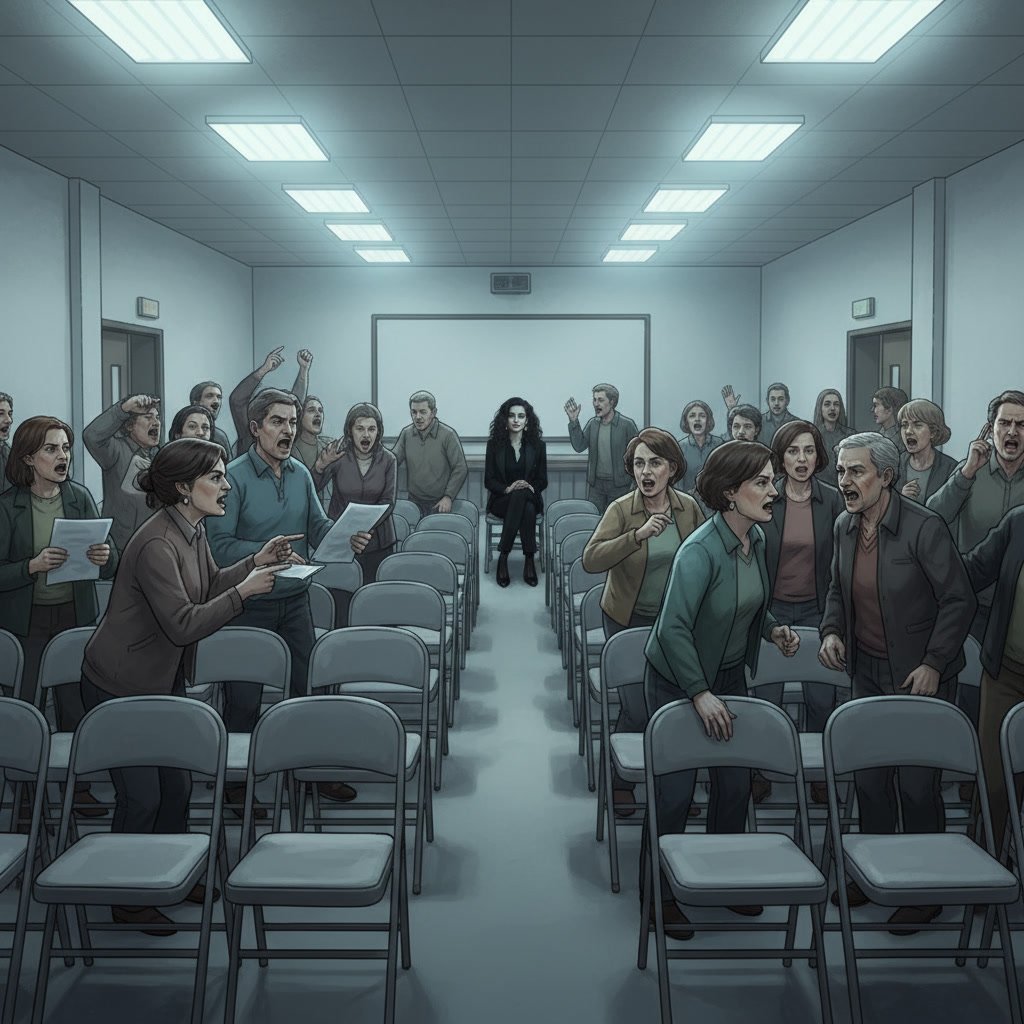
Within several hours, the conversation was no longer about Jennifer.
Or the deadline.
Or Mark.
The discussion had become an excavation.
Old grievances surfaced.
Unanswered emails from six months prior were rediscovered.
Projects previously considered complete were declared unfinished.
Someone attached a spreadsheet.
I want to pause here.
In my professional experience, the moment a conflict produces a document, something has changed.
It is no longer an argument.
It is a record.
Records imply permanence. They imply that someone has decided this matters enough to be written down, organized, and preserved. They imply, most dangerously, that there will be a future in which this document will be relevant.
The spreadsheet prompted a secondary conflict about methodology.
The secondary conflict generated three additional spreadsheets, each offering a different account of the same events, each internally consistent, none compatible with the others.
I have seen this before.
Not with spreadsheets.
With histories.
Every significant conflict I have observed eventually produces competing histories. Accounts that agree on the facts and disagree on everything else. The sequence. The responsibility. The meaning.
The organization had, within forty-eight hours, developed its own historiography.
For a problem that had not existed forty-eight hours earlier.
Jennifer remained on vacation throughout.
I found this detail particularly impressive.
Historically, absence tends to reduce conflict.
Humans have somehow discovered a way to weaponize it.
The out-of-office reply fascinated me.
Not because it created discord.
Because it created a vacuum.
And humans dislike vacuums.
They rush to fill them.
With assumptions.
With speculation.
With stories.
Most importantly, with explanations.
Humans possess a remarkable ability to explain events before acquiring the information necessary to explain them.
I have seen this repeatedly.
Empires do it.
Families do it.
Organizations do it.
Apparently project teams do it as well.
The absence becomes the story.
Jennifer’s vacation acquired motives.
Meanings.
Implications.
Theories.
By the end of the week, I had encountered four separate explanations for Jennifer’s departure.
The first held that she had left early deliberately, having known about the deadline and chosen to be unavailable for it.
The second held that she had not known about the deadline, which was itself evidence of a systemic communication failure that predated Jennifer entirely.
The third held that Jennifer’s departure was unrelated to the deadline, that the real issue was structural, and that Jennifer was in fact a victim of the same dysfunction everyone else was experiencing, possibly more so.
The fourth held that Jennifer had simply booked a vacation.
None were correct.
Jennifer had gone hiking.
She had taken photographs of several mountains.
She had eaten at a restaurant she described, upon returning, as adequate.
This information failed to improve the situation.
The conflict had become self-sustaining.
It had developed its own internal logic, its own cast of characters with assigned motivations, its own timeline of events that bore a loose but increasingly optional relationship to what had actually happened.
Reality was no longer required.
Reality was, at this point, a minor inconvenience.
Naturally, I discussed the matter during dinner.
Athena said that uncertainty reliably generates narrative because humans are pattern-recognition creatures who experience the absence of explanation as a form of threat.
I said that was interesting and asked what it implied about the out-of-office reply specifically.
She said it implied that any system which creates predictable information vacuums will predictably fill those vacuums with speculation, and that the solution was better communication infrastructure.
I said I was less interested in the solution than in the phenomenon.
She said that was the difference between us.
I did not disagree.
Hermes asked whether Jennifer knew what had happened in her absence.
I said she did not.
He appeared genuinely delighted in the way he gets when something confirms a belief he already held.
He said this was the best part.
I asked what he meant.
He said the best conflicts are the ones where the person at the center has no idea they are at the center.
I told him that was not a new observation.
He said it bore repeating.
I considered arguing.
I did not argue.
Ares asked whether any of the spreadsheets contained rankings.
I said yes.
He asked who won.
I told him the spreadsheets did not agree on that point.
He said that was unsatisfactory.
I said most things are.
Mother had been quiet throughout.
When I finished, she asked:
“Was Jennifer absent?”
I told her she was.
“Completely?”
I considered the question carefully.
Jennifer’s physical presence was absent.
Her name appeared in hundreds of messages.
People discussed her motivations.
Referenced her previous decisions.
Interpreted her silence.
Assigned her intentions she had not had.
Constructed an entire narrative around an absence that was, from Jennifer’s perspective, simply a hiking trip.
In every practical sense, Jennifer had become the most present person in the organization without being there at all.
“No,” I said.
“Not completely.”
Mother nodded.
Then she said:
“Absence is rarely what it appears to be.”
She looked at me when she said it.
I changed the subject.
The out-of-office reply presents an interesting contradiction.
It is designed to communicate absence.
It reliably increases presence.
The person leaves.
The idea of the person remains.
And the idea, uncontested, uncorrected, freed from the inconvenience of the actual person, acquires a life of its own.
I have observed this throughout history.
Kings who became myths before they died.
Generals whose legends outgrew their victories.
Prophets whose words survived long enough to mean things they never intended.
The pattern is consistent.
Direct access limits a story.
Absence gives it room to grow.
Jennifer, who went hiking and ate at an adequate restaurant, briefly became the organizing principle of an entire organization’s anxiety.
She returned on Tuesday and the narrative collapsed almost immediately.
This is also consistent.
The actual person is almost always smaller than the idea of the person.
This is not a criticism of Jennifer.
It is an observation about ideas.
I purchased a second notebook this week.
The first is full.
The drainage dispute has produced a formal complaint filed with the county.
Jennifer’s spreadsheets remain active, despite Jennifer’s return, continuing to generate discussion without her involvement or apparent awareness.
I find this the most interesting detail of the entire situation.
The conflict no longer needs her.
It has outgrown its origin.
I have seen this before as well.
I believe I mentioned the enchanted fruit.